
—contributed by Chris Allgeier, L.Ac.
With so many seasonal illnesses going around right now, I wanted to share one of my favorite Chinese medicine techniques that you can easily perform at home
Gua Sha (pronounced gwah shah) is something I frequently use with great success, not only in my clinical practice but also at home with myself and my children. It is often one of the first things I reach for when someone in our household begins to show signs of illness. One of the things I appreciate most about Gua Sha is its simplicity. You don't need any specialized equipment, and it only takes a few minutes to perform.
What Is Gua Sha?
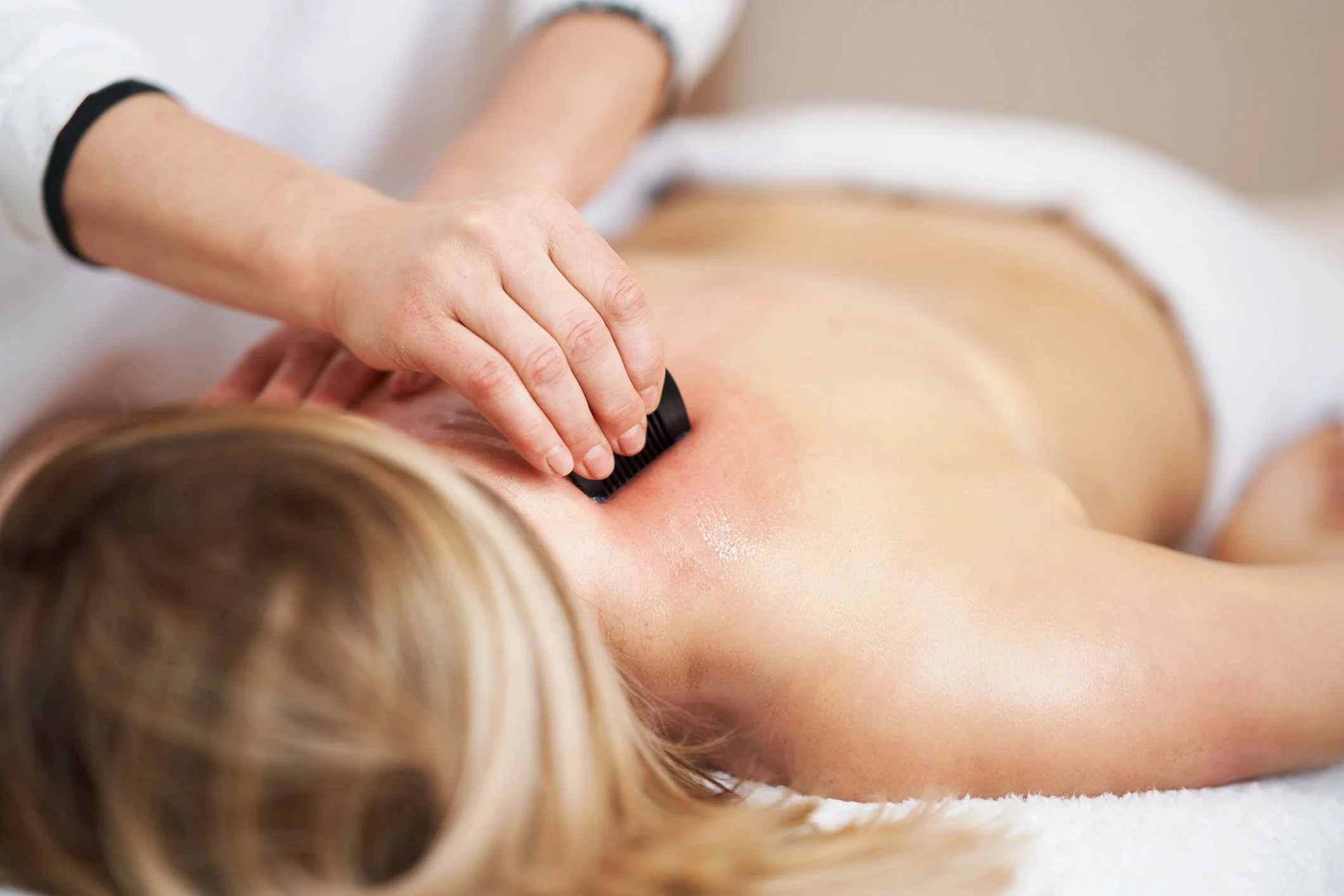
Gua Sha is a traditional Chinese medicine technique that involves repeatedly stroking the skin with a smooth-edged instrument. From a Chinese medicine perspective, it promotes the circulation of Qi and Blood and helps release what we refer to as exterior pathogenic influences.
I find it particularly useful at the initial onset of illness, when you might be experiencing:
- A scratchy or sore throat
- Mild chills
- Neck and upper back stiffness
- Headaches
- Early nasal congestion
- That familiar feeling that you're coming down with something
In Chinese medicine, we place considerable importance on addressing illness in its earliest stages, rather than waiting until symptoms have fully developed.
How to Perform Gua Sha at Home
You don't need to purchase a Gua Sha tool. A ceramic soup spoon, a mason jar lid with a smooth, rounded edge, or even a smooth-edged kitchen spatula will work. Just make sure whatever you use is clean and has no sharp or rough edges.
Apply a small amount of massage oil or another skin-safe lubricant to the back of the neck and upper back.
Begin at the base of the skull, in the soft depressions on either side of the neck. This is the location of an acupuncture point called Feng Chi (Gallbladder 20), which is commonly used in the treatment of exterior conditions.
Using comfortable, moderate pressure, stroke downward along the muscles on either side of the spine, continuing to approximately the level of the third thoracic vertebra (T3), roughly a few inches below the base of the neck.
Repeat these downward strokes on both sides for a few minutes, or until sufficient redness develops.
Avoid scraping directly over the spine or other bony prominences. It is often easier to have a spouse or family member perform the technique for you.
What Should You Expect?
Depending on the individual, the skin may become red or develop small red or purple spots known as Sha. This is a normal response to Gua Sha, and the discoloration generally resolves within several days.
You do not need to be particularly aggressive with the technique, nor do you need to force the Sha to appear. When treating children, I use considerably lighter pressure and shorter treatment times, without attempting to produce bruising or petechiae. If you are unfamiliar with performing Gua Sha on children, remember that less is often more!
Afterward, I recommend keeping the neck and upper back comfortably warm, staying well hydrated, and getting adequate rest.
Why I Recommend It
One of the things I love about Chinese medicine is that many of its therapeutic techniques can be performed at home, allowing patients to take a more active role in their own health.
Research has demonstrated that Gua Sha can increase local microcirculation, although its ability to prevent or shorten respiratory infections has not yet been firmly established. In my own clinical and personal experience, however, I have found it to be a particularly useful supportive therapy when used at the earliest signs of illness, frequently shortening the intensity and duration of the illness, if not preventing it from worsening altogether.
Gua Sha should not be painful or break the skin. Avoid performing it over damaged or irritated skin, and consult your healthcare provider first if you take blood-thinning medications, have a bleeding disorder, or bruise unusually easily. It is not a substitute for appropriate medical care, particularly when symptoms are severe, persistent, or worsening.
The next time you or someone in your household begins to feel under the weather, consider incorporating this simple technique into your routine.
As always, if you have any questions or would like a demonstration of the technique during your next appointment, please don't hesitate to ask. We are always happy to teach patients practical ways to incorporate Chinese medicine into their daily lives.